

A recent addition & renovation project brings to mind the confusion that can go along with structures, like townhomes, which are built actually touching one another. On the inside, such dwelling units are separated by some substantial wall framing, a few inches of insulation, and a couple of layers of drywall. But on the outside, they\’re separated only by an invisible Property Line, the sacred demarcation never to be breached.

…For a townhome owner who wishes to add-on and renovate, the issue is how much the new construction might affect the neighbor\’s existing townhome, as well as how much, change-wise, the neighbor is legally obligated to tolerate. Illustration 1 shows the existing state of the adjacent townhomes. Illustrations 2 and 3 show the Before and After Floor Plans. The New Covered Porch not only covers part of the Project Owner\’s area, but structurally attaches to the Next Unit, owned by the neighbor. This involves tearing out the Next Unit\’s wall-surface materials, then rebuilding the structure for the Porch attachment, then finally restoring the wall-surfaces.


…Everything just mentioned is within the common limits of the discretion of the Project Owner. A townhome owner almost always has the right to make changes and additions, even if those changes involve crossing a property line for necessary structural reasons. A privilege NOT granted by common townhome law is the freedom to make cosmetic changes to the neighboring dwelling, such as altering the color, material, or texture of the wall\’s surface. Naturally, this could change the entire \’look\’ of the affected unit. Conflicts between neighbors sometimes arise over a poor understanding of the Rights of Ownership for Townhouses.
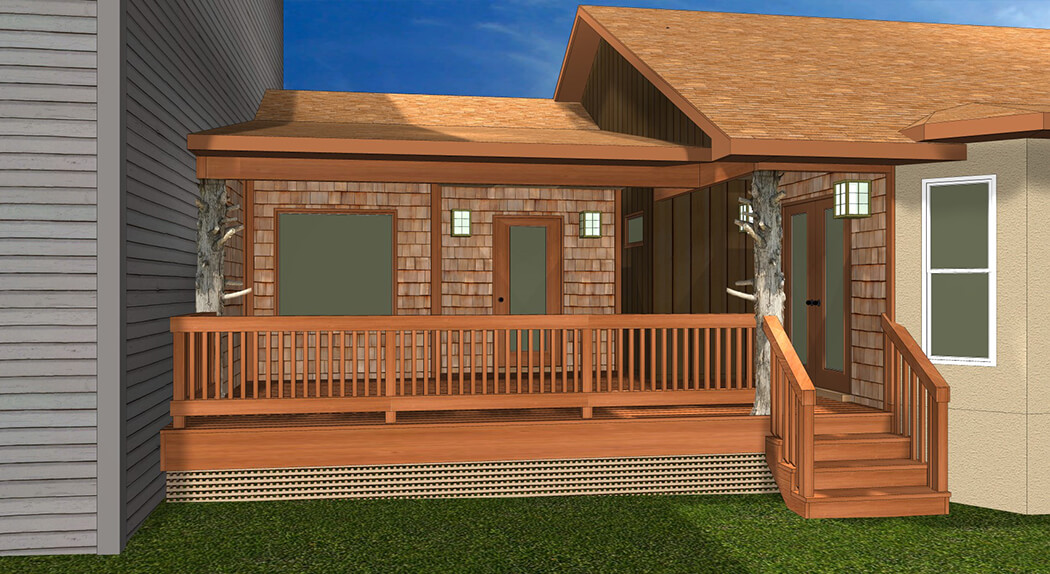
…In the case of this article, the project owner did everything right. He approached his neighbor with a proposal to refinish the entire side of the next-unit neighbor\’s common-wall, even though he was only altering a small part of it. In exchange, the two owners agreed that the small common-wall area beneath the new covered porch could have a different material, Cedar shakes. Illustration 4 shows the New Covered Porch, and the Cedar Shakes on the common wall. Detailed drawings and 3D images were presented to assure the \’next unit\’ owner that the type of new construction would still match the old-style personality of the townhome group.
…In addition were assurances that Drainage would be addressed, carefully, to make sure the new addition wouldn\’t create any new storm-drainage issues, and that old issues caused by age-settled ground between the units would be corrected as well. In an extra agreement concerning the downspout for the gutter (shown in white for clarity), the Next Unit Owner gave legally recorded permission to attach the downspout to his wall. Controlling storm drainage between both units is in the best interest of all parties.
…By carefully acknowledging the Law of Common-Walls, and by conscientiously extending Common Courtesy, even after a major change is made, everyone is happy.

[hbt_cta]
Tiny House Living
Tiny House Living

Concrete – First Look
Concrete – First Look

Wildfire (Will-Burn) Zones
Wildfire (Will-Burn) Zones

N-3 / MIND & BODY : The Dream Is Created...
N-3 / MIND & BODY : The Dream Is Created...

M-5 / Money : Borrowing, Managing, Repaying, ...
M-5 / Money : Borrowing, Managing, Repaying, ...
L-12 / BEADS KEYSTONE 14 Critical Questions t...
L-12 / BEADS KEYSTONE 14 Critical Questions t...

NECROSIS for BEGINNERS
NECROSIS for BEGINNERS
Index
Index
Secret Rooms : A Not-So-Secret Guide
Secret Rooms : A Not-So-Secret Guide
PANDEMIC PRICING AND HOMEBUILDING
PANDEMIC PRICING AND HOMEBUILDING
Home-building can be a String of Bad Decision...
Home-building can be a String of Bad Decision...

Be IndistrActable
Be IndistrActable

Codes Changing for Climate Change
Codes Changing for Climate Change
YOUR OLDIE-BUT-GOODIE DAYS : Aging-In-Place
YOUR OLDIE-BUT-GOODIE DAYS : Aging-In-Place

Favored Formula for Life
Favored Formula for Life

CLOSETS : Her Heart’s Desire
CLOSETS : Her Heart’s Desire